|
Replacement of Conventional Light Sources by LED
The latest LED technology opens up wide areas for new applications, new technical possibilities and reduced costs. The main advantages of the state of the art LED light sources are:
A. The life time of an LED reaches or frequently exceeds the life time of the application and there are often no special changes necessary. If one defines the failure criteria as end of life when the light intensity of an LED has reached 50% of the initial light intensity, depending on the model, one can calculate numerical life times above 100,000 hours for LED Chips based on GaAs. In the case of GaN – based chips (blue, true green, white) the life time is strongly dependent on the packaging technology and could be in the range between 7000 hr and 100,000 hours.
B. In the case of colored light the power consumption is below the power consumption of white light sources with filter glass (see table below). White LEDs can now reach the level of fluorescent triphosphor tubes and standard white LEDs show a better efficiency than incandescent or halogen lamps.
C. The radiant intensity of an LED is controllable in the whole range without any change in the light properties (e.g. dimming of incandescent lamps leads to a shift in color temperature) and any time loss (switching time of LEDs for general lightening < 1 μs). The PWM (pulse width modulation) is the recommended method for the dimming of LEDs. Dimming by reduced DC current may lead to inhomogeneous appearance of LED arrays.
D. Compared to the high efficient light sources of fluorescent tubes, compact lamps and metal halide high-pressure lamps the switching time of LEDs is very short. This plays an important role especially for applications like head lamps and brake lights in automotive and traffic applications.
E. LEDs provide excellent stability for mechanical and thermal stress. The reliability of an LED is described by the different failure mechanisms, the spontaneous total failure of the LED and the reduced light intensity of the LED. To calculate the reliability of an LED array one should use the data for spontaneous failure. They should be in the range of 10 ppm/h within the first hour of operation including solder processes and below 0,1 ppm after the first hours of usage.
F. The light quality of incandescent lamps is excellent (CRI 100%). White LEDs provide color rendering indices between 70% and 85%, better for daylight (6000 K) than for warm white (2900 K) LEDs.
The table below lists the properties of different light sources including costs of ownership:
Type |
Wattage |
Luminous flux init, avg |
Efficiency |
Color Rendering index Ratio |
CCT (color temperature) |
Life time |
Costs for 1 Mlm/h |
|
[W] |
[lm] |
[lm/W] |
[%] |
[K] |
[h] |
[?] |
Incandescent |
60 |
865 |
14.4 |
100 |
2790 |
1000 |
69 |
Tungsten Halogen |
50 |
590 |
11.8 |
100 |
2700-4000 |
2000 |
85 |
Fluorescent Triphosphor |
32 |
2850 |
84 |
78 |
4100 |
24000 |
12 |
Compact Fluorescent |
15 |
900 |
51 |
82 |
6000-2700 |
10000 |
20 |
Low Pressure Sodium |
90 |
12750 |
123 |
44 |
n.a. |
16000 |
8 |
High Pressure Mercury |
250 |
11200 |
34 |
50 |
3900 |
24000 |
29 |
Metal Halide |
400 |
36000 |
60 |
65 |
4000 |
20000 |
17 |
Induction Coupled Fluorescent |
55 |
3500 |
64 |
80 |
3000 |
100000 |
15 |
LED White (high end) |
1 |
70 |
70 |
85 |
6000 |
50000 |
14 |
LED White (standard) |
1 |
40 |
40 |
85 |
6000 |
50000 |
25 |
LED Warm White |
1 |
20 |
20 |
75 |
2900 |
50000 |
50 |
LED Amber |
1 |
50 |
50 |
n.a. |
n.a. |
100000 |
20 |
LED Red |
1 |
40 |
40 |
n.a. |
n.a. |
100000 |
25 |
The calculation is based on a price of 0,1 € / kWh. This LED- data has been taken from different data sheets of top suppliers. Due to the diverse applications the costs of maintenance and ownership needs to be calculated against the relevant application. The losses from power supplies has not been considered. One key aspect in the application of LEDs as light sources is the management of thermal loss. This problem is new for LED applications, typical slogans in the past has been “LEDs are low cost, low heat, and have low failure rates”. The LED producers resolved the problem of the thermal resistance between the LED chip and the connecting pad with different solutions like metal core PCB, specially designed lead frames, TO based solutions and ceramic-based packages.
A good solution can be to provide a thermal resistance between p/n junction and solder pads below 20 K/W. The excess heat can be removed by different passive and active ways, very often the metal core P.C.B. or flexible P.C.B. directly mounted on a heat sink, air fan or in specials cases water cooling is used to keep the p/n junction temperature below the critical limit. In addition one should consider that the radiant intensity has a negative temperature coefficient. As an example red LEDs have an TC in the range of -0,5 % / °C and an increase of the p/n junction temperature from room temperature (20°C) up to 85 °C reduces the radiant intensity by 32.5%.
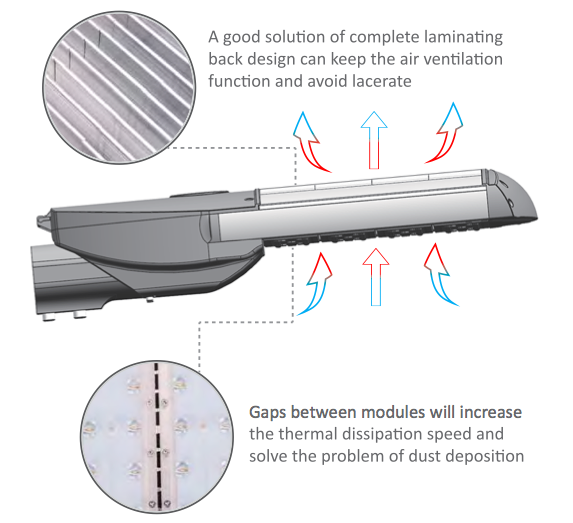
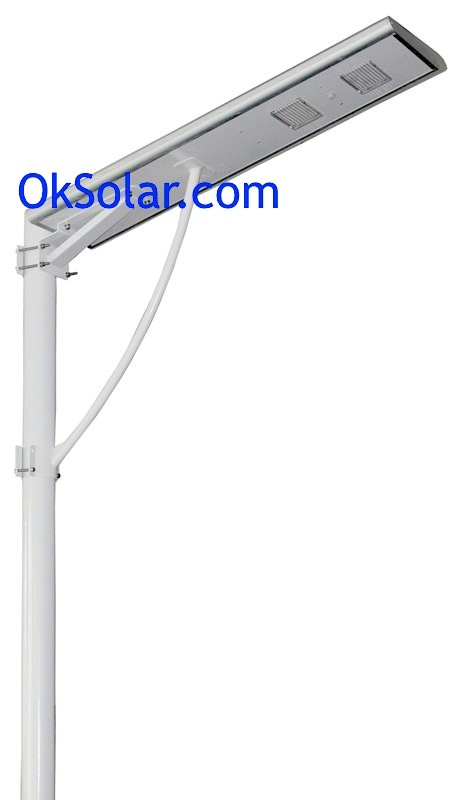
The picture shows a solution for the thermal management of a warm white LED source for a street lamp. The warm white LED modules for this street lamp were developed by OSA Opto Light GmbH, Germany.
In this case a LED with a thermal resistance below 10 K / W has been mounted on a metal core PCB. The circuit also includes intelligent temperature protection. The metal core PCB is directly mounted onto a passive cooling system and on to the metal housing of the lamp itself. In operation this system provides in equilibrium a temperature gradient between the p/n- junction and the metal lamp housing below 50°C.
In the case of a direct replacement of an existing light source by a LED light source a few aspects have to be carefully considered, including:
a. The thermal management of an incandescent filament or tungsten halogen lamp is designed on the fact, that the thermal radiation is the way to remove the heat from the lamp. Thus the thermal conductivity of the socket is very low. A replacement process has to ensure that the LED is protected from high temperature.
b. The power supplies of most conventional lamps are constant voltage sources, typical between 6V / 12V and 220V. LEDs require constant current sources and have a forward voltage between 1.5 V (IRED) and 4 V Power supply. A very common way is a current limitation resistor or a constant current source with bipolar transistor. The power consumption at the resistor determines the total power consumption and not the LED itself. In the case of a 24 V System the power consumption of a red LED sign (UF = 2 V, I= 30 mA, P=60 mW) is 720 mW. State of the art power step down converters are a way to resolve this (also thermal) problem.
c. Conventional white light sources are used for colored signs and indicators in combination with a filter glass. Often the phantom effect of the filter glass is desired. The replacement should consider the absorption of the LED emitted light carefully.
d. Conventional light sources are compared to high end white, blue and green LED chips insensitive to ESD / short high voltages. The whole unit (often the LED itself) has to provide adequate protection.
e. Especially yellow and 565 - 570 nm green LEDs show a visible shift of the dominant wavelength over the required temperature range. An easy but expensive way to resolve this problem is to combine a white LED with a color filter.
Considering all the aspects shown above, the direct replacement of conventional lamps is an interesting way to increase the reliability of systems and to reduce the real costs of ownership. The state of the art LEDs show clear advantages for all applications, where colored light sources are necessary. In the not too distant future we will see white LED light sources with further cost benefits and increased external efficiency, which will again show clear advantages over conventional light sources.
Solid State Lighting (SSL) refers to a type of lighting that utilizes light-emitting diodes (LEDs), organic light-emitting diodes (OLED), or polymer light-emitting diodes as sources of illumination rather than electrical filaments or gas. The term "solid state" refers to the fact that light in an LED is emitted from a solid object—a block of semiconductor—rather than from a vacuum or gas tube, as is the case in traditional incandescent light bulbs and fluorescent lamps. Unlike traditional lighting, however, SSL creates visible light with virtually no heat or parasitic energy dissipation. In addition, its solid-state nature provides for greater resistance to shock, vibration, and wear, thereby increasing its lifespan significantly.
SSL has been described by the United States Department of Energy as a pivotal emerging technology that promises to alter lighting in the future. It is the first new lighting technology to emerge in over 40 years and, with its energy efficiencies and cost savings, has the potential to be a very disruptive technology in the marketplace as well.
Basic Knowledge about Different Kinds of LED
Power Supplies
Although LED’s power saving efficiency is higher than
ordinary light sources, it can not be connected directly to
public grid voltage like those ordinary ones. It should be
configured with special voltage switching device which can
supply it with rated voltage and current, providing a sound
condition for it to function in normally. That is the
so-called special power supply for LED.
However, LED power supplies with different specifications
hold different performance and different switching
efficiency. In order to fully bring into play the high
efficiency of LED, it is important to choose a proper, high
efficiency special power supply for each distinct LED. Low
efficiency LED power supplies consume large amount of power
supply, which will influence the energy saving trait of LED.
Anyhow, the stability, power saving trait and the life-span
of LED largely depends on choosing a proper LED power
supply.
Different types of LED power supplies
LED power supply can be classified into two types according
to driving modes:
A. Constant current power supply
a. Constant current driving circuit is ideal to drive LED,
except for its little bit high cost.
b. Constant current circuit can load short-circuit, but it
is forbidden to load fully open circuit.
c. The output current in the constant current driving
circuit is constant; however, the output DC voltage changes
within a certain range according to different load
resistance values.
d. The total amount of LED used in one circuit should be
limited, because LED has its maximum current and voltage
value restriction.
B. Stabilized voltage power supply
a. After setting each parameter in the stabilized voltage
circuit, the output voltage is settled, whereas the output
current is variational according to the loading.
b. Stabilized voltage circuit can load open circuit, but it
is forbidden to load short-circuit.
c. The luminance of the LED will be influenced by the change
of voltage after rectification.
d. Proper resistance should be configured in each series of
circuit so that LEDs in stabilized voltage circuit will have
uniform luminance.
LED power supply can be classified into six types according
to the structure of the circuit:
a. Conventional transformer step-down
Although the size of this kind of power supply is very
small, it is a bit heavy and the efficiency is very low, at
about 45%~60%. Also its reliability is not high, so it is
seldom used.
b. Electronic transformer step-down
The disadvantages of this kind of power supply is its low
switching efficiency, narrow voltage range (about 180~240V)
and its strong ripple interference.
c. Capacitance step-down
This kind of LED power supply can easily be influenced by
the grid voltage fluctuation and the efficiency is very low.
It is inadvisable to use it in flashing LEDs because the
charge and discharge process in the capacitance step-down
circuit will causing extremely large instant current flow,
which can easily damage the chip in the flashing LEDs.
d. Resistance step-down
The power supply efficiency in this kind of circuit as well
as its reliability is very low. The circuit is interfered by
the grid voltage fluctuation, so it is difficult for the
power supply to stabilize its voltage. Large power
consumption is another disadvantage for this resistance
step-down power supply.
e. RCC step-down switching power supply
Advantages: wide range of stabilized voltage; high power
supply efficiency (at about 70%~80%). So it is widely used.
Disadvantages: difficult to control the switching frequency;
large ripple coefficient of the load voltage; weak loading
adaptability in abnormal condition.
f. PWM control switching power supply
At present, the PWM control switching power supply is much
more ideal than other kinds of power supplies. Its output
voltage and current are very stable, and the efficiency can
reach as high as 80%~90%. This kind of LED power supply is
made up of four parts: input rectification filter; output
rectification filter; PWM voltage stabilizing control unit;
power switching unit. High reliability is another advantage
for this power supply because the circuit is well protected.
History
For the past 150 years, lighting technology was mainly limited to incandescence and fluorescence. While derivative technologies such as high-intensity discharge lamps (HID) have emerged, none have achieved energy efficiencies exceeding 25%, with incandescent lighting achieving an efficiency of less than 2%. With the advent of commercial LEDs in the 1960s, however, the door for the most radical and exciting form of lighting technology had opened. Unlike conventional lighting, LEDs consume less electricity and have largely avoided the parasitic by-products of its predecessors: heat.
Initial LEDs were red in color, with yellow and orange variants following soon thereafter. To produce a white SSL device, however, a blue LED was needed. Advances in materials science and extensive research and development on the subject did just that. In 1993, Shuji Nakamura of Nichia Chemical Industries came up with a blue LED using gallium nitride (GaN). With this invention, it was now possible to create white light by combining the light of separate LEDs (red, green, and blue), or by creating white LEDs themselves by means of doping. SSL could now become a commercial viability.
Technology Overview
A single LED can produce only a limited amount of light, and only a single color at a time. To produce the white light necessary for SSL, light spanning the visible spectrum (red, green, and blue) must be generated in correct proportions. To achieve this effect, three approaches are used for generating white light with LEDs: wavelength conversion, color mixing, and most recently Homoepitaxial ZnSe.
Wavelength conversion involves converting some or all of the LED’s output into visible wavelengths. Methods used to accomplish this feat include:
- Blue LED & yellow phosphor – Considered the least expensive method for producing white light. Blue light from an LED is used to excite a phosphor which then re-emits yellow light. This balanced mixing of yellow and blue lights results in the appearance of white light.
- Blue LED & several phosphor – Similar to the process involved with yellow phosphors, except that each excited phosphor re-emits a different color. Similarly, the resulting light is combined with the originating blue light to create white light. The resulting light, however, has a richer and broader wavelength spectrum and produces a higher color-quality light, albeit at an increased cost.
- Ultraviolet (UV) LED & red, green, & blue phosphors – The UV light is used to excite the different phosphors, which are doped at measured amounts. The colors are mixed resulting in a white light with the richest and broadest wavelength spectrum.
- Blue LED & quantum dots – A process by which a thin layer of nanocrystal particles containing 33 or 34 pairs of atoms, primarily cadmium and selenium, are coated on top of the LED. The blue light excites the quantum dots, resulting in a white light with a wavelength spectrum similar to UV LEDs.
Color mixing involves utilizing multiple LEDs in a lamp and varying the intensity of each LED to produce white light. The lamp contains a minimum of two LEDs (blue and yellow), but can also have three (red, blue, and green) or four (red, blue, green, and yellow). As no phosphors are used, there is no energy lost in the conversion process, thereby exhibiting the potential for higher efficiency.
Homoepitaxial ZnSe Blue LED is an LED developed by Sumomito Electric where a homoepitaxial ZnSe blue LED is grown on a ZnSe substrate, which simultaneously produces blue light from the active region and yellow emission from the substrate. The resulting white light has a wavelength spectrum on par with UV LEDs. Here also no phosphors are used, resulting in a higher efficiency white LED.
To be considered SSL, however, a multitude of LEDs must be placed close together in a lamp to amplify their illuminating effects. This is because an individual LED produces an only limited amount of light, thereby limiting its effectiveness as a replacement light source. In the case where white LEDs are utilized in SSL, this is a relatively simple task, as all LEDs are of the same color and can be arranged in any fashion. When using the color-mixing method, however, it is more difficult to generate equivalent brightness when compared to using white LEDs in a similar lamp size. Furthermore, degradation of different LEDs at various times in a color-mixed lamp can lead to an uneven color output. Because of the inherent benefits and greater number of applications for white LED based SSL, most designs focus on utilizing them exclusively.
Advantages of SSL
Technological Comparison
SSL is intended to be a cost-effective yet high quality replacement for incandescent and fluorescent lamps. To better understand the technical merits of SSL, it is important to understand the technology behind the lamps it intends to replace.
- Incandescent lamps (light bulbs) create light by running electricity through a thin filament, thereby heating the filament to a very high temperature and producing visible light. The incandescing process, however, is considered highly inefficient, as over 98% of its energy is emitted as invisible infrared light (or heat). Incandescent lamps, however, are relatively inexpensive to produce. The typical lifespan of an incandescent lamp is around 1,000 hours.
- Fluorescent lamps (light bulbs) work by passing electricity through mercury vapor, which in turn produces ultraviolet light. The ultraviolet light is then absorbed by a phosphorous coating inside the lamp, causing it to glow, or fluoresce. While the heat generated by fluorescent lamps is much less than its incandescent counterpart, efficiencies are still lost in generating the ultraviolet light and converting this light into visible light. In addition, mercury is detrimental to health, and should the lamp break, exposure to the substance can be hazardous. Fluorescent lamps are typically five to six times the cost of incandescent lamps, but have life spans around 10,000 hours.
- SSL achieves its purpose by grouping smaller LEDs in an orderly fashion, thereby creating a unified beam. The SSL can be comprised of multiple white LEDs, or from ones that are color-mixed—where LEDs of different colors are mixed to produce white light. The inherent advantages and disadvantages of SSL are the same as those of an LED. Advantages include:
- High durability - no filament or tube to break
- Long life span - LEDs last approximately 100,000 hours
- Low power consumption - reduces overall electricity bill
- Flexible application –small size of LEDs can lead to unique lighting devices
- Low heat generation – very little parasitic energy loss
Currently, however, there is no SSL on the market that can be offered as a true replacement for incandescent or fluorescent lamps, even though several manufacturers have gone forward with the introduction of such products. White LEDs produced today are too expensive to be considered affordable, and the lumens produced by the LEDs today are not as bright as traditional lighting. Future developments in LED technologies, however, will address most of these issues. Based on research conducted by the Department of Energy (DOE) and the Optoelectronics Industry Development Association (OIDA), it is expected that by the year 2025, SSL will be the preferred method of illumination in homes and offices.
The following chart, derived from information from Sandia National Laboratories, compares a perfected SSL device (to be released before 2025) with incandescent and fluorescent lights
| Technology |
SSL |
Incandescent |
Fluorescent |
| Luminous Efficacy (lm/W) |
200 |
16 |
85 |
| Lifetime (khr) |
>100 |
1 |
10 |
| Flux (lm/lamp) |
1,500 |
1,200 |
3,400 |
| Input Power (W/lamp) |
7.5 |
75 |
40 |
| Lumens Cost ($/klm) |
< 2 |
0.4 |
1.5 |
| Lamp Cost ($/lamp) |
<3 |
0.5 |
5 |
| Color Rendering Index (CRI) |
>80 |
95 |
75 |
Benefits
A 2001 study conducted by the DOE indicated that over 7.2 Quads (quadrillion British Thermal Units – BTUs) were used that year to provide lighting for commercial, residential, and industrial buildings and stationary fixtures in the USA. With America’s steady growth and limited resources, this continued rate of consumption is not sustainable. Recognizing the need for change, the DOE has set a goal to reduce electric lighting consumption 50% by 2025. SSL technologies are uniquely positioned to address this need, and at the same time
- reduce CO2 emissions, thereby positively affecting the greenhouse effect
- decrease by 50% the global amount of electricity used for lighting
- provide higher quality lighting
- decrease by 10% the total global consumption of electricity (projected to be about 1.8 TW-hr/year, or $120B/year, by the year 2025)
- reduce projected 2025 global carbon emissions by about 300 Mtons/year
- create new industries and jobs
The U.S. Government, by way of the DOE and other agencies, has funded millions of dollars in research grants and projects relating to the development of a high quality yet affordable SSL. A major motive of funding such research, in addition to its environmental impact and energy savings potential, is to decrease dependence on foreign fossil fuels.
Challenges
Technological Hurdles
The current manufacturing process of white LEDs has not matured enough to be produced cost-effectively. Among the manufacturing hurdles to overcome include improving the processes used to deposit the active semiconductor layers of the LED, thereby increasing yields and throughput as well as decreasing costs. Problems with phosphors and their ability to emit a broader wavelength spectrum light have also been an issue. In particular, the untunability of absorption and emission, and inflexibility of form in phosphors have been issues in their spectral capabilities.
More apparent to the end user, however, is the low Color Rendering Index (CRI) of current LEDs. The CRI is widely used to measure how accurately a lighting source renders the color of objects. Sunlight and incandescent lamps have CRI of 100, while fluorescent lamps have CRI >75. The current generation of LEDs, which employs mostly blue LED chip + yellow phosphor, has a CRI around 70, which is much too low for widespread use in lighting particularly indoors. In order for SSL to effectively replace incandescent lamps, more research must be done on developing alternatives to the techniques currently used that address these concerns.
Variations of CCT (color correlated temperature) at different viewing angles present another formidable obstacle against widespread use of white LED. It has been shown, that CCT variations can exceed 500K, which is clearly noticeable by human observer, who is normally capable of distinguishing CCT differences of 50 to 100K in range from 2000K to 6000K, which is the range of CCT variations of daylight.
Adaptation Hurdles
Potential pitfalls to the widespread adaptation of SSL
devices include lighting fixture issues and general consumer
resistance. Fixture issues can be overcome either by
replacement of the fixture, or a modified SSL device that
would fit into the socket. With the ubiquity of SSL, it is
believed that any customer resistance will be dissipated
over time
Research and DevelopmentIn order to further the development of SSL technology, the DOE has committed more than $50 million on over 45 applied research projects, including short- and long-term projects at large and small businesses, universities and national labs alike. Part of the department's goals include developing a better quality, lower cost, and highly efficient white LED.
Other agencies and universities contributing to SSL development include:
- Sandia National Laboratories
- Rensselaer Polytechnic Institute
- National Electrical Manufacturers Association
Future
Solid State Lighting has the potential to be one of the most disruptive technologies to come to market to date. If and when the technological hurdles that are present today are overcome, it will provide long-term benefits both environmentally and economically. Various research organizations and government labs are currently working towards finding the ideal white LED, which would usher in a new era in the world of lighting.
Reference
Wikipedia the free encyclopedia
|
LED Street Lights Specifications
Manufacturers of LED solar street light, LED
solar power street lights,
LED Lighting Hazardous Locations, Replaces HPS
250W - Equal to HPS Lumen 13,600
Manufacturers of LED solar street light, LED
solar power street lights, LED Lighting
Hazardous Locations, LED Lighting Hazardous Locations, Replaces HPS
250W LED Street Lights Specifications
LED Streetlight,
LED Street Light, LED Street Lamp, Solar
Streetlight, LED Bulb, LED Lamp, LED Lighting,
LED Traffic,
Traffic Signal,
Traffic Controller,
Traffic NEMA Enclosures
Contact US today!
Easy to retrofit IQ LED streetlights can easily
retrofit existing metal halide, high pressure sodium
and mercury vapor luminaries.
Your next schedule IQLED maintenance will be in 8 to
10
years!
with our IQ Retrofit Lamps
IQLED Unlike bulb streetlights,
IQLED lighting
modules produce very intense light in tightly
control IQLED directions. There is no longer a need for
reflectors or cut-off shields to minimize light
pollution and trespass. With IQLED energy usage less
than 20% and lifespan more than seven times that of
conventional streetlights, payback occurs very early
in a long life cycle. One specific advantage of LEDs
is that they produce directional light. This gives
you more control over what you light (i.e. the
street) and what you don't (the night sky), reducing
light pollution and wasted energy.
LED has significantly better lumen
maintenance LED fixture typically doesn’t need
relamping to 70,000 hours. if you are looking
for LED Street Lights, LED Streetlights, LED Street
Lamps, Retrofit LED Street Lights, Solar LED Street
Lights, LED Traffic Lights, LED Traffic Signals,
Retrofit LED Modules, High Power LED Bulbs, LED
Lamps, LED Spot Lamps or some other customized LED
Lighting products, Please do not hesitate to contact
NOW!
|
 |
 |
 |
 |
 |
 |
 |
|
01681000 |
01540 |
488300 |
01420 |
01503 |
01440 |
488500 |
 |
|
 |
 |
 |
|
|
|
No Bulbs!
No Ballasts! No
Starters!
Its
Ok NO
Problems
With IQLED, you are limited only by Your imagination
in the use or design of your Lighting fixtures.
We
design, manufacture and deliver state of the art, LED Lighting
Solutions
IQLED.com
Green
Lighting solutions for indoor and outdoor
uses, in both ac and dc voltages for: residential, commercial,
retail, industrial, municipal, government, medical, military,
transit, aeronautic/space, and for mission critical industries. If
you are not able find what you are looking for, we can custom design
and produce it for a reasonable cost. Contact us with your ideas or
lighting requirements Today!.Flex Strips: Flexible, LED
strips with customizable LED options for architectural
installations. Retrofit Bulbs: Screw in ac/dc LED retrofits
bulbs with customizable LED and lens configurations.
Streetlight Retrofits: Shoebox, drop down, acorn and cobra head
LED streetlight retrofit solutions.
 IQLED Green Lighting solutions environmentally friendly, outdoor
LED streetlighting has arrived. Designed to be efficient, low glare
and Dark Sky compliant, our full line of IES certified LED
streetlights can easily retrofit existing metal halide, high
pressure sodium and mercury vapor luminaries.
Nontoxic, RoHS compliant, made with environmental friendly
materials, we fabricate LED streetlight retrofits for box style,
cobra head, acorn and dropdown or entirely custom LED streetlights
based on specifications, requirements or aesthetics.
Our IQLED Streetlight
retrofits can be installed with not effort, while still utilizing
existing power, housing and lens. Built using segmented
construction, each LED Streetlight, consists of individual panels;
combating vandalism and enabling easy access to replace damaged
components. IQLED
designed to operate in extreme conditions, our LED streetlights
don’t flicker or hum, require no warm up time and can operate in -40
to +180 degrees Fahrenheit.
Will Provide substantial security lighting for your parking lot,
garage or workspace; aim the light where it is needed, curb high
utility and maintenance costs and avoid polluting the night sky with
excess light, with our full line of certified, low voltage, LED
Streetlighting retrofits. Download lumen ratings and IES
certification for our LED Streetlight retrofits: LED
lights use half the energy (or less) and last longer
than conventional bulbs, resulting in big savings
and short payback periods. One specific advantage of
LEDs is that they produce directional light. This
gives you more control over what we light (i.e. the
street) and what we don't (the night sky), reducing
light pollution and wasted energy.
Saving energy and money.
The new IQLED lens fixtures use less energy,
helping to keep operating costs down. After
three years, The City will regain the cost of
installing the new fixtures from energy and
maintenance savings.
Reducing greenhouse gas emissions. Using
less electricity reduces the emissions produced
by gas and coal-burning generators. When the IQLED Streetlights project is completed, carbon
dioxide emissions will be reduced.
Reducing glare to increase visibility.
Glare from street lights is significantly
reduced with the new IQ LED's street-light
fixtures, increasing visibility by directing
light onto the roadway and preventing it from
shining into the eyes of motorists.
Reduce excessive lighting and light
pollution. New ways of designing and
providing street lighting have been developed in
the last several years.
Maintaining a safe level of lighting. Street
lighting on residential and collector roads will
continue to meet minimum Illuminating
Engineering Society (IES) guidelines.
If your City is committed to
savings and reduce the level of light pollution
by using the most efficient IQ LED
street-light fixtures and employing the latest
design methods.
New series of IQLED lamps 'Brighter
than HID' linear lighting as well as TYPE
III roadway lamps that meet IES specs from 35'
mounting heights!
IQLED Modular LED Luminaire systems.
allow you to design your own Luminaire (Fixture)
|
-
Weatherproof for coastal climates
-
Vibration resistant for tunnels and bridges
-
Withstand 160 MPH winds
-
LED fixture rated to withstand mechanical vibration per MIL-STD 883, test
method 2007, using three 4-minute cycles along x, y
and z axis, at a force of 2.5 Gs, with a frequency
sweep from 2 Hz to 120 Hz.
-
Manufactures in accordance with MIL Specs, ISO
9001:2000, ROHS Compliant parts Quality
Standards.
-
Solid-State long life “hi-flux/hi-power ”IQLED's.
-
Shock
and vibration resistant.
-
Eliminate unsafe hazardous disposal.
-
Eliminate “cold-start” problems; no ballast.
-
Rugged waterproof design.
-
Better visibility with excellent Lumen
efficiency.
-
Environmentally friendly.
-
Substantial energy & maintenance savings.
-
Expected life > 50K + hours; 3 year warranty.
-
Approximate 3-year payback.
-
Significant Operational Savings- Energy &
Maintenance.
-
High color rendition - objects appear more
natural than with bulb lighting
-
More than
5 times longer life than
conventional
-
High reliability and minimal maintenance
-
The modules are supplied with glass replacement
panel, lens, power supply and
terminations/leads. Expected product life is 10
years with an approximate 3-year payback period,
depending upon local energy & maintenance cost
savings.
-
How to Retrofit Street Lights with LED by IQLED
-
High Power LED Street Light Manufacturer and
Exporter of LED Street Lights
-
Replacement of Conventional Light Sources by LED
Streetlight, LED Street Light IQLED.com
Contact us today! |

|
|
|
Specifications Series
|
Operating Voltage |
90 to 265 VAC, 47 to 63 Hz |
|
Wattage |
48-180 Watts |
|
Power Factor |
>0.90 |
|
Intensity Regulation |
Better than 10% |
|
Color Temperature |
5,000 to 5,500 °K |
|
CRI |
65 (typical) |
|
Lumens |
na |
|
Operating Temp |
-35°C to 60°C |
|
Storage Temp. |
-40°C to 85°C |
|
Humidity |
0 –99% |
|
Electrical Wire |
3 x 24 inch, 18 AWG leads,
Female slip terminal |
|
Size |
Emitting area 8.25”x 8.25” |
|
IQLED's |
one-watt white Hi-Flux |
|
Watts |
Replaces
HPS |
Equal to HPS Lumen Efficiency
of |
| 48W |
75W |
3,300 |
| 60W |
125W |
4,400 |
|
80W |
150w |
6,000 |
| 100W |
175W |
7,600 |
| 125W |
200W |
9,400 |
| 140W |
250W |
10,600 |
|
180W |
320W |
13,800 |
|
|
Note: HPS Wattages do not include
ballast wattages; only the lamp ratings. |
|
|
Brightness Estimated equivalency:
* Note: HPS Wattages do not include ballast
wattages; only the lamp ratings.
** Note: IQLED Luminaries
produce high quality white light @ 5500K
color temperature which greatly enhances the
nighttime visibility, color rendition &
Scotopic (nighttime) visibility of the human
eye.
Note: Meets IES minimum requirements for
roadway lighting.
IQLED Series Luminaries
utilize hi-power white IQLED's with superior
thermal management design. These extremely
durable fixtures are waterproof and designed
for multiple applications including indoor
and outdoor.

125Watts
|
| 100,000 Hours
LED Life Expectancy |
| Years |
16 |
22 |
45 |
54 |
68 |
91 |
136 |
| Operating Hours per day |
7 |
6 |
5 |
4 |
3 |
2 |
1 |
|
eco IQLED
Retrofit to MR16
LED based products (B22, GU10) high power LED
Light Bulbs clear bright and white light.
Led Spot lights, 3 1w MR16 high power led
lamp, 1, 3 and 5 watt LED Luxeon Bulbs, gu10
bulbs, e27 bulbs
-
Optimized
thermal management
-
Selectable
beam angles
-
Full range of
light output colors
-
Low heat
-
No UV
-
LED Luxeon Bulbs, 1/3/5
Watt, MR16/GU10/E27 Base
Application:
This LED spot light is widely used in Airport
signaling, Street lighting, advertise
lighting, mall, hotel, club, disco hall, casino,
coffee bar, bank, meeting room, exhibition,
walkway, show window, navigation signal etc.
High Power Led Tunnel and SubWay
Light:
Revolutionary Photometric Design-The
world’s first dedicated optical
system(rectangular beam focusing
lens): Reasonable control of the
light distribution, spot rectangular
bean pattern ,and ensure an ideal
uniformity of brightness on the road
surface, eliminate the glare and
keep the LED lighting efficiency on
a high level, no light pollution

LED Tunnel Light
-
Tremendous Energy Saving: Used
the ultra high power, high
brightness LED light source
,together with the high power
efficiency power supply, which
can save energy 50%-80% than the
conventional sodium and mercury
lamp
-
Intelligent current control,
achieve the precision constant
current: Each LED module can
implement intelligent current
control, whatever power network
how to wave, it is able to
achieve the precision constant
current, ensure the LED can work
under the secure curren
-
No Strobe Flashing: Eliminate
the visual fatigue which caused
by the strobe lights of the
traditional tunnel lamps.
-
Perfect Support intelligent
control: such as combine Tunnel
lighting starts shortly as
trait(<2 seconds), Adopt the
newest technology of tunnel
lighting intelligent control,
when no vehicles pass tunnel, It
can put out most of lamps, when
vehicles pass tunnel entrance at
within 500m area, It can start
lighting automatically. So It
has solved the problem of
smaller tunnel traffic which no
vehicles pass the tunnel will
waste a great deal of electric
power sources. Supply a new idea
“establish saving society” to
city road management
|
|
Night sky wildlife compliant bulbs
IQLED Illumination
|
High Power LED Street Light: High
Power Led Streetlight
Designed to eliminate glare, light
trespass, and sky glow, the LED
street lights only shine light at
ground level. Multiple colors
Temperature from 3000K to 7500K are
available, suitable for different
area and situation. The Power varies
from from small security yard, to
Major road. The lamp applies high
power LED. Fine cooling system
applied. The average life time of
the system can be high up to 50,000
hours, lighting 10-11 hours a day,
the light can be used for more than
11 years.
Parking Garage - Municipal garages
Item#01450
|

Item#
01460 |
|
Note
the brightness of IQLED Lamps compared to Incandescent Lamps!

 |
 |
|